Yes. /joː/ in euro, Eurovision, eurocentric, anything beginning with /joːrɐy̯-/, /jʊ/ in Europe and European.
English questions
Re: English questions
Re: English questions
I have come to the conclusion that the best analysis of the dialect here probably is that it has phonemic vowel and consonant quantity, phonemic vowel (and rhotic) nasality, and a phonemic fortis/lenis distinction even in places where it is normally neutralized. At the same time, I would analyze many surface geminates as clusters rather than phonemic geminates, and analyze many frequently elided consonants as being unelided if the pattern of their elision is regular and their unelided forms still surface. Also, many surface diphthongs, all surface overlong vowels, and some surface long vowels would be analyzed as vowel clusters.
Why do I think this? The reason is that elisions are irregular in distribution, resulting in surface forms that cannot be predicted from more conservative analyses. Take for instance the form [me̞ːj] for maybe ─ it must be analyzed as /meːi/ as the conservative analysis /ˈmebi/ cannot take into account the irregular elision of /b/ in this word. Yet at the same time, forms (particularly consonants) predicted by more conservative analyses are liable to resurface in many cases without requiring spelling pronunciation, implying that the resulting consonants are still underlyingly there. Take for instance the form [ˈvaːkːə(ː)] for vodka ─ it must be analyzed as /ˈvaːdkə/ rather than /ˈvaːɡkə/ as the form [ˈvaːt̚kə(ː)] may still surface spontaneously, if infrequently.
This results in a quandary ─ effectively, both more radical and more conservative analyses must apply simultaneously, so an analysis that accurately predicts the surface forms must contain both.
Why do I think this? The reason is that elisions are irregular in distribution, resulting in surface forms that cannot be predicted from more conservative analyses. Take for instance the form [me̞ːj] for maybe ─ it must be analyzed as /meːi/ as the conservative analysis /ˈmebi/ cannot take into account the irregular elision of /b/ in this word. Yet at the same time, forms (particularly consonants) predicted by more conservative analyses are liable to resurface in many cases without requiring spelling pronunciation, implying that the resulting consonants are still underlyingly there. Take for instance the form [ˈvaːkːə(ː)] for vodka ─ it must be analyzed as /ˈvaːdkə/ rather than /ˈvaːɡkə/ as the form [ˈvaːt̚kə(ː)] may still surface spontaneously, if infrequently.
This results in a quandary ─ effectively, both more radical and more conservative analyses must apply simultaneously, so an analysis that accurately predicts the surface forms must contain both.
Yaaludinuya siima d'at yiseka wohadetafa gaare.
Ennadinut'a gaare d'ate eetatadi siiman.
T'awraa t'awraa t'awraa t'awraa t'awraa t'awraa t'awraa.
Ennadinut'a gaare d'ate eetatadi siiman.
T'awraa t'awraa t'awraa t'awraa t'awraa t'awraa t'awraa.

Re: English questions
Weird, as it's obvious those words start with the same prefix, you'd expect that by analogy they either Europe would get [o] or the other words [ʊ].
JAL
Re: English questions
I should explain that my [oː] isn't GOAT, it's NORTH/THOUGHT/FORCE/CURE, which is the long vowel corresponding to [ʊ] (PUT).
I think the difference is the second vowel. Where euro- is a prefix, the o is GOAT; in Europe and European it's just schwa. Not that I can think of any analogical cases with other long/short pairs.

Re: English questions
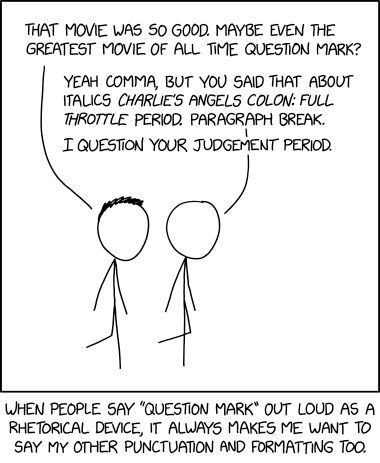
The latest skcd makes me ask, "Wait, is that actually a thing in everyday English these days?"
Re: English questions
The main forms of spoken punctuation I am familiar with in English in the wild are ending a sentence with "period" and the use of "quote" and "unquote".
Yaaludinuya siima d'at yiseka wohadetafa gaare.
Ennadinut'a gaare d'ate eetatadi siiman.
T'awraa t'awraa t'awraa t'awraa t'awraa t'awraa t'awraa.
Ennadinut'a gaare d'ate eetatadi siiman.
T'awraa t'awraa t'awraa t'awraa t'awraa t'awraa t'awraa.

Re: English questions
It's not super common and it's quite jocular, but yes: "Question mark" can appear as a tag question for me, nearly always separated with a pause from the rest of the sentence.
Re: English questions
Does anyone else's variety of English have special cliticized forms for was and were that are contrastive with the typical cliticized forms for is and are? I ask because I never see these mentioned in discussions of English but they are very common in the English here.
Yaaludinuya siima d'at yiseka wohadetafa gaare.
Ennadinut'a gaare d'ate eetatadi siiman.
T'awraa t'awraa t'awraa t'awraa t'awraa t'awraa t'awraa.
Ennadinut'a gaare d'ate eetatadi siiman.
T'awraa t'awraa t'awraa t'awraa t'awraa t'awraa t'awraa.
Re: English questions
I'm not sure what you mean. Could you give an example?Travis B. wrote: ↑Thu Sep 18, 2025 10:58 pm Does anyone else's variety of English have special cliticized forms for was and were that are contrastive with the typical cliticized forms for is and are? I ask because I never see these mentioned in discussions of English but they are very common in the English here.
Re: English questions
Thank you!
Re: English questions
I'm not sure what would be a good test of cliticisation. I have forms with reduced vowels, which retain /w/, but I'm not sure if they count.Travis B. wrote: ↑Thu Sep 18, 2025 10:58 pm Does anyone else's variety of English have special cliticized forms for was and were that are contrastive with the typical cliticized forms for is and are? I ask because I never see these mentioned in discussions of English but they are very common in the English here.
Re: English questions
In the dialect here, was and were when unstressed can be heard as /ɵz/* [ɵːs] and /ɵr/** [ʁ̩ʷˤ(ː)] respectively. These do not merge with cliticized is and are, as shown as it was /ˈɪtɵz/ [ˈɨɵːs] and you were /ˈjuɵr/ [ˈjyu̯ʁ̩ʷˤ(ː)] which contrast with it's /ɪts/ [ɨʔts] and you're /jɔr/~/jər/ [jɔ(ː)ʁˤ]~[jʁ̩ˤ(ː)].
* This is a rounded version of commA which can be heard in words such as photograph /ˈfoʊtɵˌɡræf/ [ˈfo̞ɾɵːˌɡʁˤɛf]; this vowel is notable because it does not participate in the weak vowel merger.
** This is my rounded version of the NURSE/lettER vowel I mentioned elsewhere on here.
* This is a rounded version of commA which can be heard in words such as photograph /ˈfoʊtɵˌɡræf/ [ˈfo̞ɾɵːˌɡʁˤɛf]; this vowel is notable because it does not participate in the weak vowel merger.
** This is my rounded version of the NURSE/lettER vowel I mentioned elsewhere on here.
Yaaludinuya siima d'at yiseka wohadetafa gaare.
Ennadinut'a gaare d'ate eetatadi siiman.
T'awraa t'awraa t'awraa t'awraa t'awraa t'awraa t'awraa.
Ennadinut'a gaare d'ate eetatadi siiman.
T'awraa t'awraa t'awraa t'awraa t'awraa t'awraa t'awraa.
Re: English questions
I guess not really in AusEng. was is /wɒz/ when stressed and /wəz/ otherwise; were is /wɵː/ ~ /wə/. So it was, you were /ˈit wəz, ˈjuː wə/ vs. it's, you're /ˈits, ˈjoː/. You can drop the it in it was in fast speech though.
Re: English questions
Google doesn't seem to know anything about cliticized forms of was and were, so this must be an oddity of the English here.
Yaaludinuya siima d'at yiseka wohadetafa gaare.
Ennadinut'a gaare d'ate eetatadi siiman.
T'awraa t'awraa t'awraa t'awraa t'awraa t'awraa t'awraa.
Ennadinut'a gaare d'ate eetatadi siiman.
T'awraa t'awraa t'awraa t'awraa t'awraa t'awraa t'awraa.
-
zompist
- Site Admin
- Posts: 4358
- Joined: Sun Jul 08, 2018 5:46 am
- Location: Right here, probably
- Contact:
Re: English questions
I'm not sure cliticized is the right analysis here; this sound more like a sandhi phenomenon.Travis B. wrote: ↑Fri Sep 19, 2025 9:37 am In the dialect here, was and were when unstressed can be heard as /ɵz/* [ɵːs] and /ɵr/** [ʁ̩ʷˤ(ː)] respectively. These do not merge with cliticized is and are, as shown as it was /ˈɪtɵz/ [ˈɨɵːs] and you were /ˈjuɵr/ [ˈjyu̯ʁ̩ʷˤ(ː)] which contrast with it's /ɪts/ [ɨʔts] and you're /jɔr/~/jər/ [jɔ(ː)ʁˤ]~[jʁ̩ˤ(ː)].
As maybe a silly example, think of the joke about needing to have "round toits", based on expressions like "I'll get around to it." Is either "to" or "it" a clitic here? Surely it's just that phrases easily become phonological units due to sandhi?
Re: English questions
If this were a sandhi phenomenon one would expect it to occur whenever a highly unstressed word beginning with /w/ follows another word ─ but you don't see this with words such as what (which in the English here begins with /w/), for instance.zompist wrote: ↑Fri Sep 19, 2025 7:59 pmI'm not sure cliticized is the right analysis here; this sound more like a sandhi phenomenon.Travis B. wrote: ↑Fri Sep 19, 2025 9:37 am In the dialect here, was and were when unstressed can be heard as /ɵz/* [ɵːs] and /ɵr/** [ʁ̩ʷˤ(ː)] respectively. These do not merge with cliticized is and are, as shown as it was /ˈɪtɵz/ [ˈɨɵːs] and you were /ˈjuɵr/ [ˈjyu̯ʁ̩ʷˤ(ː)] which contrast with it's /ɪts/ [ɨʔts] and you're /jɔr/~/jər/ [jɔ(ː)ʁˤ]~[jʁ̩ˤ(ː)].
As maybe a silly example, think of the joke about needing to have "round toits", based on expressions like "I'll get around to it." Is either "to" or "it" a clitic here? Surely it's just that phrases easily become phonological units due to sandhi?
Yaaludinuya siima d'at yiseka wohadetafa gaare.
Ennadinut'a gaare d'ate eetatadi siiman.
T'awraa t'awraa t'awraa t'awraa t'awraa t'awraa t'awraa.
Ennadinut'a gaare d'ate eetatadi siiman.
T'awraa t'awraa t'awraa t'awraa t'awraa t'awraa t'awraa.
-
zompist
- Site Admin
- Posts: 4358
- Joined: Sun Jul 08, 2018 5:46 am
- Location: Right here, probably
- Contact:
Re: English questions
What isn't highly unstressed— quite the opposite.
How do you say I'll get back to you when I'm done? For me, at a fast clip, "to you when" is highly compressed, close to [tyun̩].
Re: English questions
I tried that and got [ˈaːɯ̯ˌɡɜʔp̚ˈpɛʔk̚tjəˌwɜ̃ːːmˈtʌ̃].
Yaaludinuya siima d'at yiseka wohadetafa gaare.
Ennadinut'a gaare d'ate eetatadi siiman.
T'awraa t'awraa t'awraa t'awraa t'awraa t'awraa t'awraa.
Ennadinut'a gaare d'ate eetatadi siiman.
T'awraa t'awraa t'awraa t'awraa t'awraa t'awraa t'awraa.
Re: English questions
How do people here use and conjugate "lie" and "lay"?
- For me, "lie" the word meaning to tell falsehoods, is "lie, lied" in the present and past, respectively.
- "lie" the word meaning to rest on a flat surface (intransitively) is "lie, laid" or lacks a past tense. Using "lay" as it's past tense just sounds wrong.
- "lay" the word also meaning to rest on a flat surface (transitively) is "lay, laid", and is also often used intransitively, especially in informal registers.
- For me, "lie" the word meaning to tell falsehoods, is "lie, lied" in the present and past, respectively.
- "lie" the word meaning to rest on a flat surface (intransitively) is "lie, laid" or lacks a past tense. Using "lay" as it's past tense just sounds wrong.
- "lay" the word also meaning to rest on a flat surface (transitively) is "lay, laid", and is also often used intransitively, especially in informal registers.
Re: English questions
I am the same way as you here.jcb wrote: ↑Wed Oct 01, 2025 2:06 pm How do people here use and conjugate "lie" and "lay"?
- For me, "lie" the word meaning to tell falsehoods, is "lie, lied" in the present and past, respectively.
- "lie" the word meaning to rest on a flat surface (intransitively) is "lie, laid" or lacks a past tense. Using "lay" as it's past tense just sounds wrong.
- "lay" the word also meaning to rest on a flat surface (transitively) is "lay, laid", and is also often used intransitively, especially in informal registers.
Yaaludinuya siima d'at yiseka wohadetafa gaare.
Ennadinut'a gaare d'ate eetatadi siiman.
T'awraa t'awraa t'awraa t'awraa t'awraa t'awraa t'awraa.
Ennadinut'a gaare d'ate eetatadi siiman.
T'awraa t'awraa t'awraa t'awraa t'awraa t'awraa t'awraa.